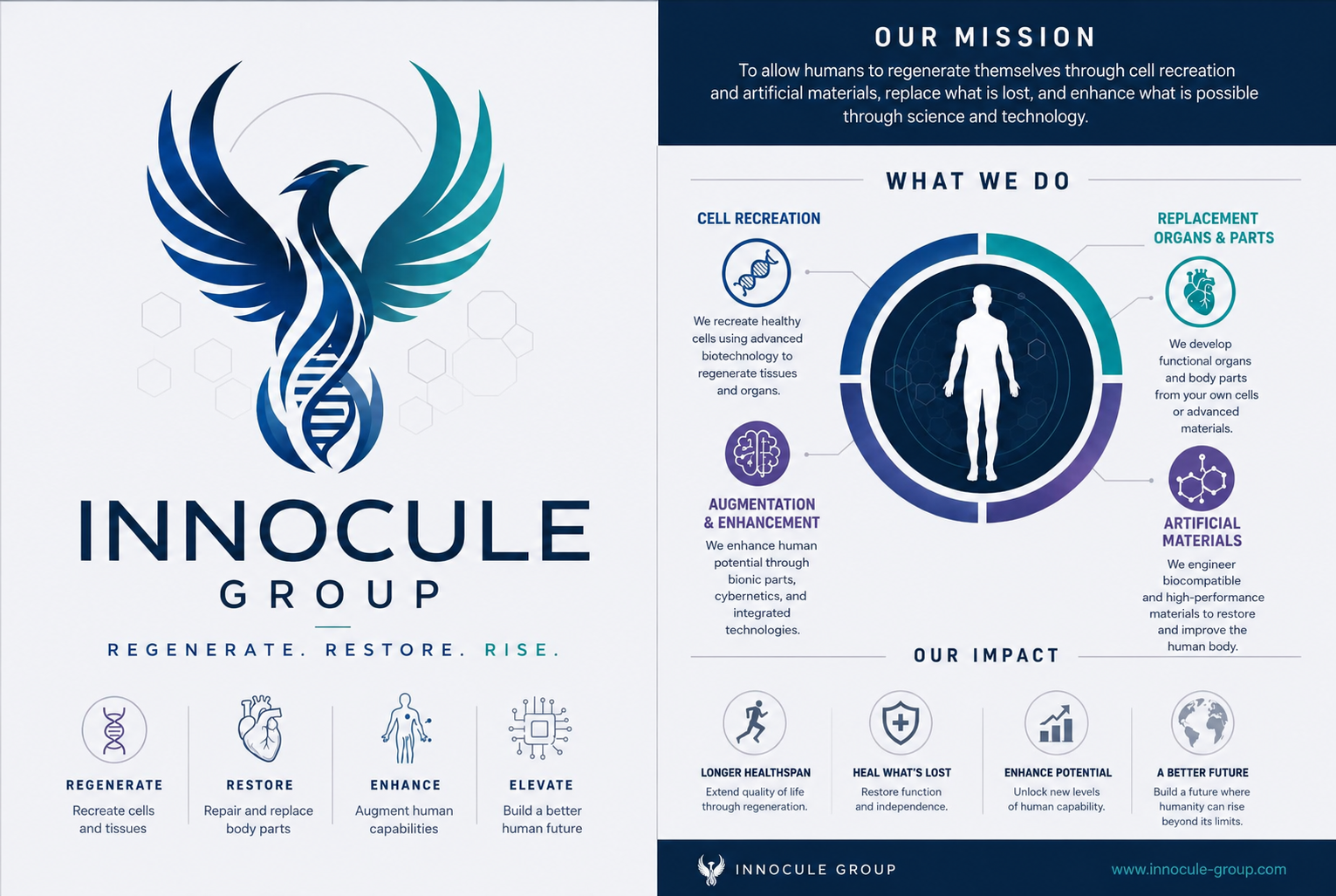
Innocule Group imagines a future world where humans will gradually replace all of their body parts with enhanced parts and will reemerge like phoenixes from humans to bionic hybrids, through 3D Printing, Gene Editing, Cell Manipulation, and Silicon Wafer Integration.
The company is registered in Delaware, with operations in Silicon Valley and Hyderabad. Its parent company (Infinite Loop) provides financing, management expertise, and direction from Bahrain. The company is inspired by the Theseus Paradox: an object (such as a ship) whose components are gradually replaced remains fundamentally the same yet is totally different.
The company focuses on exploring technologies related to human repair, regeneration, and medical innovation. The group works at the intersection of biology, engineering, and materials science, with an emphasis on understanding how emerging technologies can be applied in practical and commercially viable ways over time.
Its work is research-driven and long-term in nature, starting with early-stage exploration and progressing selectively into areas that show clear potential. As capabilities develop, Innocule Group aims to support the development of products or businesses in relevant fields, working with partners and specialists where appropriate.
Areas under development include 3D printing of human bones using a patient’s own cells or advanced biomaterials, integration of microprocessors with the human brain, regeneration or replacement of organs through cell-based therapies and advanced materials, the application of gene-editing technologies such as CRISPR to treat or potentially cure inherited genetic diseases, and the development of advanced cellular engineering techniques to improve the function, resilience, and regenerative capacity of healthy human cells. The group also explores other emerging technologies that have the potential to transform human health and longevity.
Innocule Pharmaceuticals
Innocule Pharmaceuticals develops and manufactures high-quality pharmaceutical products with an initial focus on affordable generic medicines for domestic and international markets. Through our pharmaceutical operations in Hyderabad, India, we aim to build scalable manufacturing capabilities while maintaining rigorous standards of quality, safety, and regulatory compliance.
Over time, Innocule Pharmaceuticals plans to expand beyond conventional generics into more complex formulations, specialty pharmaceuticals, novel drug-delivery systems, and selected proprietary medicines. The company will also explore partnerships, licensing opportunities, and acquisitions that can accelerate its development into a diversified global pharmaceutical business.
Our long-term objective is to combine the scale and accessibility of pharmaceutical manufacturing with advances in biotechnology, computational drug discovery, and precision medicine.
Innocule Genomics & CRISPR
Innocule Genomics & CRISPR is envisioned as the Group’s future platform for genetic medicine, gene editing, and genomic technologies.
The division intends to pursue research into technologies capable of identifying, preventing, and ultimately treating diseases at their genetic source. Areas of long-term interest include CRISPR-based gene editing, gene therapies, genomic diagnostics, personalized medicine, and technologies for modifying cellular function.
Development would begin through research collaborations, investments, licensing, and recruitment of specialized scientific teams before progressing toward proprietary intellectual property and therapeutic programs.
In the longer term, Innocule aims to contribute to a future in which medicine increasingly moves from managing the symptoms of disease toward correcting underlying biological causes.
Innocule Neurotech
Innocule Neurotech is envisioned as a future neurotechnology business focused on technologies connecting the human nervous system with advanced computing, electronics, and artificial intelligence.
Potential areas of research include brain-computer interfaces, neural implants, peripheral nerve interfaces, neurostimulation systems, and technologies designed to restore sensory or motor functions lost through disease or injury.
The initial objective would be medical: developing technologies that could help restore movement, communication, hearing, vision, or other neurological functions. Longer-term research may investigate increasingly sophisticated interfaces between biological and digital systems.
By combining neuroscience, microelectronics, artificial intelligence, and advanced materials, Innocule Neurotech’s long-term ambition would be to help develop a new generation of technologies capable of restoring—and eventually potentially augmenting—human capabilities.
Innocule Bioprinting
Innocule Bioprinting is envisioned as the Group’s regenerative-medicine and tissue-engineering platform, exploring technologies that could ultimately enable biological tissues and replacement organs to be manufactured for individual patients.
Research would initially focus on areas such as biomaterials, tissue scaffolds, cellular engineering, 3D bioprinting, and the production of relatively simple biological structures. As these technologies mature, the long-term objective would be to progress toward increasingly complex functional tissues and organs.
The ultimate vision is a future in which damaged or failing biological structures can increasingly be repaired or replaced using living tissue engineered specifically for the patient.
Such technologies could potentially transform transplantation and regenerative medicine by reducing dependence on donor organs and improving biological compatibility.
Innocule Bionics
Innocule Bionics would focus on technologies that replace or restore human physical functions through the integration of engineering, robotics, electronics, advanced materials, and biology.
Initial areas of interest could include advanced prosthetic limbs, intelligent orthotics, robotic rehabilitation systems, artificial sensory systems, and electronically controlled medical implants.
Over time, these technologies could increasingly integrate with Innocule Neurotech, allowing prosthetic and artificial systems to communicate more directly with the nervous system and respond naturally to human intention.
The long-term objective is to move beyond conventional prosthetics toward sophisticated bionic systems that reproduce increasingly complex biological functions and improve mobility, independence, and quality of life.
Innocule Regenerative Medicine
Innocule Regenerative Medicine would investigate technologies designed to stimulate the body’s own ability to repair and regenerate damaged tissues.
Areas of long-term research would include stem-cell technologies, cellular therapies, tissue regeneration, biomaterials, organ repair, and technologies for influencing cellular aging and recovery.
The division would work particularly closely with Innocule Bioprinting and Innocule Genomics, combining cellular engineering, genetic technologies, and advanced manufacturing to develop new approaches to repairing the human body.
The longer-term ambition would be to shift medicine progressively from replacement and symptom management toward biological restoration and regeneration.